

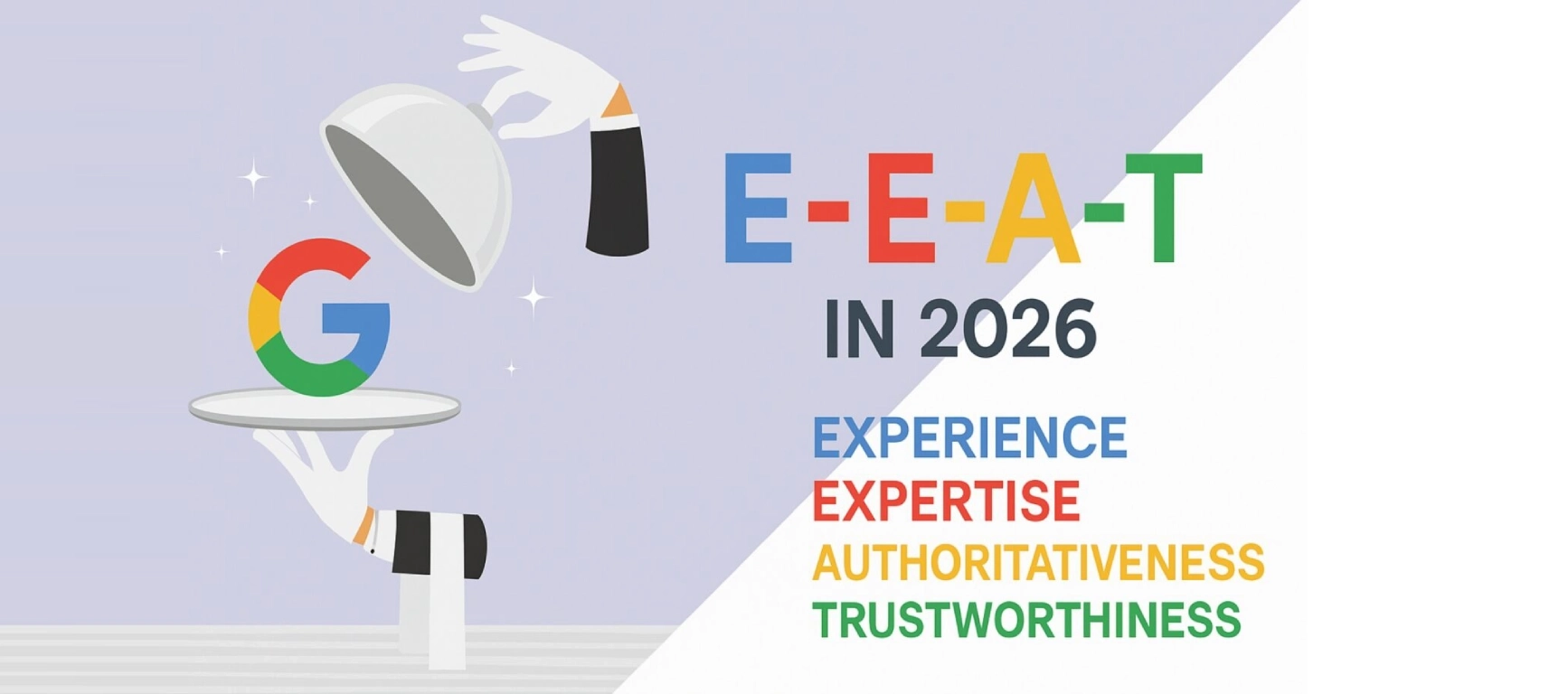
Future of E-E-A-T in 2026: Expertise, Experience and Trust
Search engine optimisation has always been about staying one step ahead of change. But as we move into 2026, one thing has become very clear: Google is no longer just ranking content, it’s judging credibility. The concept of E-E-A-T (Experience, Expertise, Authoritativeness, and Trustworthiness) is no longer a supporting framework. It is becoming the backbone of how content is evaluated, ranked, and surfaced.
In a search environment shaped by AI-generated answers, zero-click results, and increasingly sceptical users, Google’s priority is simple: show information that can be trusted. And that trust is built through real expertise, genuine experience, and strong signals of authenticity.
Let’s break down what the future of E-E-A-T looks like in 2026, and how brands can prepare for it.
What Is E-E-A-T?
E-E-A-T stands for Experience, Expertise, Authoritativeness, and Trustworthiness. It originates from Google’s Search Quality Evaluator Guidelines and is used as a framework to assess the overall quality and reliability of content.
While E-E-A-T itself is not a single ranking factor, it influences many Google ranking factors that determine visibility in search results. Pages that demonstrate clear expertise, real-world experience, and trust signals tend to perform better, especially in competitive or sensitive categories like finance, healthcare, education, and legal services.
In simple terms, E-E-A-T answers one question:
“Why should Google, and users, believe you?”
Why E-E-A-T Will Matter More in 2026
Search in 2026 will be more personalised, more AI-assisted, and more cautious than ever before. With an explosion of AI-generated content, Google’s biggest challenge is separating useful, authentic information from mass-produced noise.
This is where E-E-A-T becomes critical.
Google is increasingly prioritising:
- Who created the content
- Why they are qualified to speak on the topic
- Whether they have real experience
- Whether users trust and engage with the content
As algorithms evolve, expertise in SEO will no longer be about gaming keywords—it will be about building long-term credibility across content, brand presence, and user experience. Brands that invest in strong content quality signals and transparent authorship will gain a clear advantage.
Experience: A New Core Component
The addition of “Experience” to E-A-T marked a major shift. In 2026, this element will carry even more weight.
Google wants proof that content is written by people who have actually done what they’re talking about. First-hand knowledge, personal insights, case studies, and lived examples help search engines and users distinguish between theoretical information and practical guidance.
Content that reflects real use, testing, or involvement will consistently outperform generic summaries, especially in product reviews, tutorials, and advisory content.
How to Build E-E-A-T Signals
Building E-E-A-T isn’t about ticking boxes. It’s about aligning your content, brand, and digital presence with how trust is formed in the real world.
Here’s how that translates into action.
Expert Content Creation
Expertise starts with people.
In 2026, content that performs well will clearly show:
- Who wrote it
- What qualifies them to write it
- Why their perspective matters
This means moving beyond anonymous blog posts. Author bios, professional credentials, industry experience, and even social proof all contribute to perceived expertise.
Content should also reflect depth, not surface-level information. Thoughtful analysis, original insights, and clear explanations signal that the creator understands the subject, not just the keywords.
If your SEO strategy focuses only on volume, it will struggle. If it focuses on authority, it will scale.
Demonstrating Real-World Experience
Experience signals are becoming more measurable.
Google looks for:
- First-person language where appropriate
- Real examples, use cases, or outcomes
- Visual proof such as original images, videos, or screenshots
- Content that aligns with how users actually behave and search
For brands, this means showcasing behind-the-scenes knowledge, customer stories, hands-on demonstrations, and practical insights gained through real work.
Strong UX & SEO alignment also plays a role here. When users spend time engaging with your content, navigating intuitively, and returning for more, those behaviours reinforce experience and trust.
Trust & Credibility Best Practices
Trust is built through consistency and transparency.
In 2026, strong trust signals include:
- Clear contact information and business details
- Secure websites (HTTPS, privacy policies, disclaimers)
- Accurate, up-to-date content
- Honest claims backed by evidence
- Positive brand mentions and reviews across the web
Google cross-references these signals with external sources. A well-optimised site supported by strong off-site credibility performs far better than isolated content.
This is why investing in long-term SEO foundations, rather than quick wins, remains essential.
Final Thoughts
The future of SEO is not about tricks or shortcuts, it’s about trust.
In 2026, E-E-A-T will separate brands that simply publish content from those that genuinely deserve attention. By investing in real expertise, showcasing lived experience, and building transparent trust signals, businesses can future-proof their visibility in an increasingly selective search ecosystem.
Those who treat credibility as a strategy, not an afterthought, will lead the next era of organic search.
FAQs
What is E-E-A-T in SEO?
E-E-A-T is a quality framework used by Google to assess content credibility. It focuses on experience, expertise, authority, and trust to determine whether content deserves visibility in search results.
Can E-E-A-T improve rankings in 2026?
Yes. While E-E-A-T is not a direct ranking factor, it strongly influences many ranking signals. As Google prioritises reliable information, strong E-E-A-T signals will play a major role in ranking success in 2026.
How do you measure experience signals?
Experience signals are measured indirectly through user behaviour, content depth, originality, engagement metrics, and contextual relevance. First-hand insights, authentic examples, and user interaction all contribute to stronger experience indicators.