

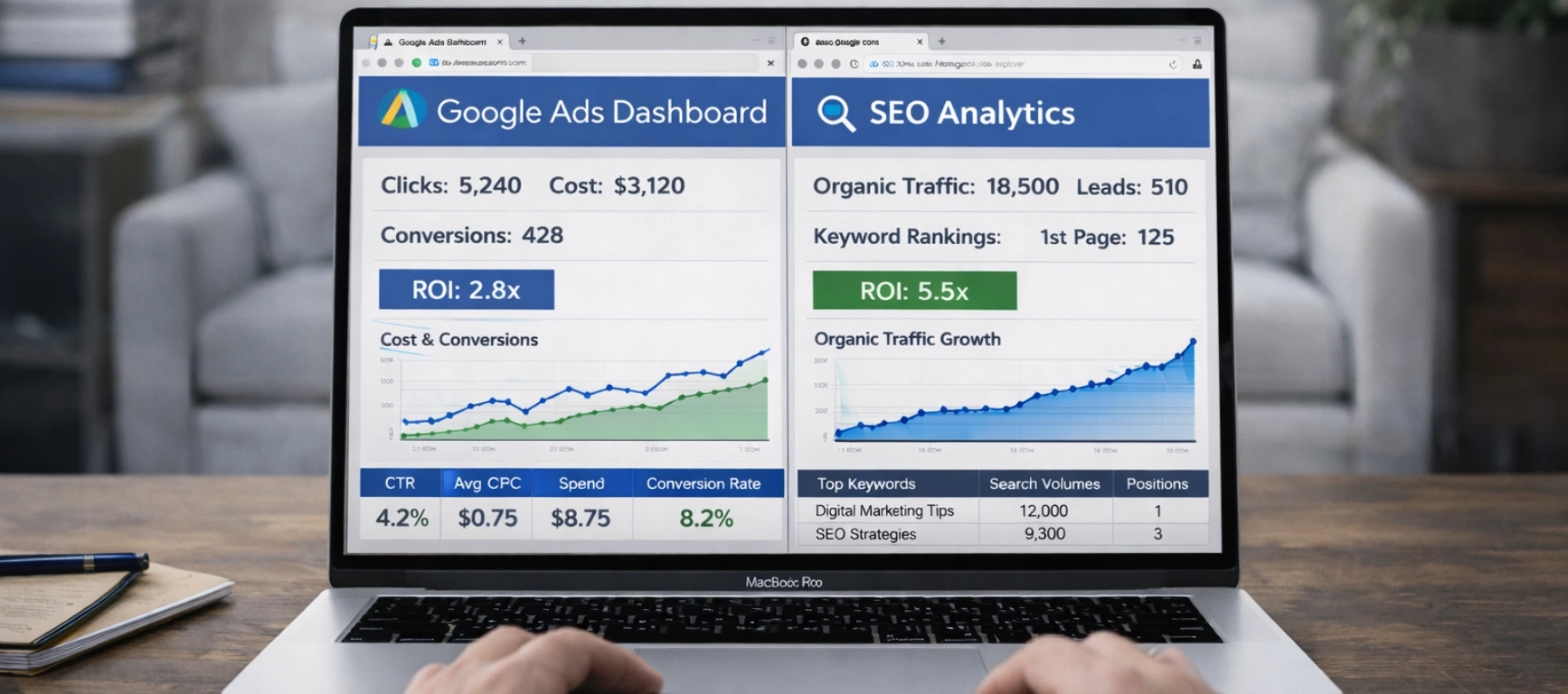
Google Ads vs SEO: Which Strategy Drives Better ROI?
While making an investment in digital marketing this year, this is an important question: should you give more importance to paid advertising or instead, to organic growth? Businesses are continuously evaluating the advantages of Google Ads management versus SEO strategies over a long time period. Both play an important part in driving visibility, generating leads, and increasing revenue. However, both work in their own different ways.
For making the right digital marketing decisions, it is important to fully understand how both impact ROI or Return On Investment).
Understanding Paid Search Advertising
Paid search advertising, or PPC, gives businesses the opportunity to instantly appear on the top of search query results, by strategically placing bids on important keywords. By deploying carefully structured PPC campaigns, advertisers can compete with competitors in real-time auctions. When a search is done for a relevant keyword, Google instantly evaluates these four things:
- Ad relevance
- Your bid amount
- Expected click-through rate
- Quality score
You advertise on a cost per click (CPC) model, which implies that you will be charged only when someone clicks your ad. This ensures paid search marketing is both controllable and measurable.
Why Businesses Choose Paid Search
- Immediate visibility
- Highly targeted audience selection
- Predictable traffic flow
- Fast testing of offers and messaging
Unlike SEO, paid traffic can begin generating leads within hours of launching a campaign. If your sales pipeline needs instant momentum, paid traffic offers that speed.
However, once you stop paying, the traffic stops. That’s the trade-off.
If you’re building structured, performance-focused campaigns, professional PPC Services can help optimize bidding, targeting, and ad creatives for better results.
Long-Term Value of SEO
SEO works differently. Instead of paying for placement, you earn rankings by optimizing your website’s content, authority, and technical structure.
While SEO takes time, it builds sustainable visibility. Once you rank organically, traffic continues without paying for every click.
Why Businesses Invest in SEO
- Compounding traffic growth
- Higher long-term trust and credibility
- Lower customer acquisition cost over time
- Sustainable brand authority
SEO is not about immediate wins; it’s about durable positioning. Strong organic rankings often deliver higher lifetime ROI because they don’t depend on daily ad budgets.
Strategic SEO Services integrate technical optimization, content strategy, and authority building to create long-term visibility.
Cost Comparison Over Time
When comparing Google Ads management and SEO, cost structure is one of the biggest differences.
Google Ads:
- Ongoing ad spend required
- Competitive industries have high CPC
- Scaling requires increased budget
- ROI depends on efficient optimization
SEO:
- Higher upfront investment
- No per-click charges
- Results compound over time
- Traffic becomes more cost-efficient long-term
For example:
- PPC may cost $10 per click in competitive markets.
- SEO might take 6–8 months to rank, but once ranking, those clicks are essentially “free.”
In short:
- PPC = rent visibility
- SEO = own visibility
The right answer often depends on how quickly you need results and how long you plan to invest.
Conversion Intent Differences
Another key ROI factor is user behavior.
Users clicking paid ads often have strong transactional intent. They’re actively searching for services or products and ready to act. This can lead to faster conversions.
However, many users trust organic results more. Studies consistently show higher click-through rates for top organic listings compared to ads in certain industries.
Here’s the difference:
Paid Search Marketing
- Immediate, high-intent targeting
- Excellent for product launches
- Strong for limited-time promotions
SEO
- Captures informational and transactional searches
- Builds awareness earlier in the buyer journey
- Strengthens brand trust
Conversion rates vary depending on industry, but the smartest marketers measure not just cost per click, they measure ROAS (Return on Ad Spend) and long-term customer lifetime value.
When to Combine SEO and PPC for Maximum Results
The most successful businesses don’t choose one, they integrate both.
Here’s when combining strategies works best:
- Launch Phase:
Use PPC for immediate traffic while SEO builds. - Keyword Testing:
Run ads to identify high-converting keywords, then optimize SEO pages for those terms. - SERP Domination:
Appear in both paid and organic results to increase visibility and credibility. - Retargeting:
Use paid campaigns to re-engage organic visitors who didn’t convert.
By aligning PPC campaigns with organic content strategy, businesses maximize visibility across the entire funnel.
Think of PPC as acceleration and SEO as foundation.
Which Delivers Better ROI?
There’s no universal answer. It depends on:
- Budget size
- Industry competition
- Business maturity
- Revenue goals
- Timeline expectations
If you need fast leads and can afford ongoing ad spend, paid search marketing delivers quick wins.
If you’re building long-term authority and want compounding growth, SEO delivers stronger long-term ROI.
In reality, the highest-performing brands invest in both strategically.
Final Thoughts
Choosing between SEO and paid search marketing isn’t about picking a winner, it’s about understanding your growth stage.
Google Ads management offers speed, control, and measurable scalability. SEO offers compounding growth, credibility, and cost efficiency over time.
If your strategy is short-term revenue acceleration, PPC may deliver faster ROI. If your goal is long-term dominance and sustainable brand authority, SEO is the stronger foundation.
The smartest businesses build both engines, and let them work together.
FAQs
1. Is Google Ads better than SEO for small businesses?
It depends on budget and urgency. PPC provides fast results, while SEO builds sustainable growth over time.
2. How fast does PPC show results?
Traffic can start within hours or days after launching campaigns.
3. Should businesses invest in both SEO and PPC?
Yes, combining both often maximizes visibility and lead generation.
4. How long does SEO take to show results compared to PPC?
SEO typically takes 3–6 months for measurable improvement, while PPC delivers immediate traffic.
5. What budget is required to run a successful PPC campaign?
Budgets vary by industry, but competitive markets may require higher daily spend due to rising cost per click.
6. Can PPC help improve SEO performance?
Indirectly, yes. PPC provides keyword data and traffic insights that can strengthen SEO strategy.
7. How do I measure ROI from SEO and PPC campaigns?
Track conversions, revenue generated, cost per acquisition, and ROAS.
8. Is PPC suitable for local businesses?
Absolutely. Local targeting allows precise audience reach and fast lead generation.
9. When should a business prioritize SEO over PPC?
When long-term growth, brand authority, and sustainable traffic are primary goals.
10. Can small businesses compete with larger brands using PPC?
Yes, with smart targeting, niche keywords, and optimized Google Ads management, smaller brands can compete effectively.